
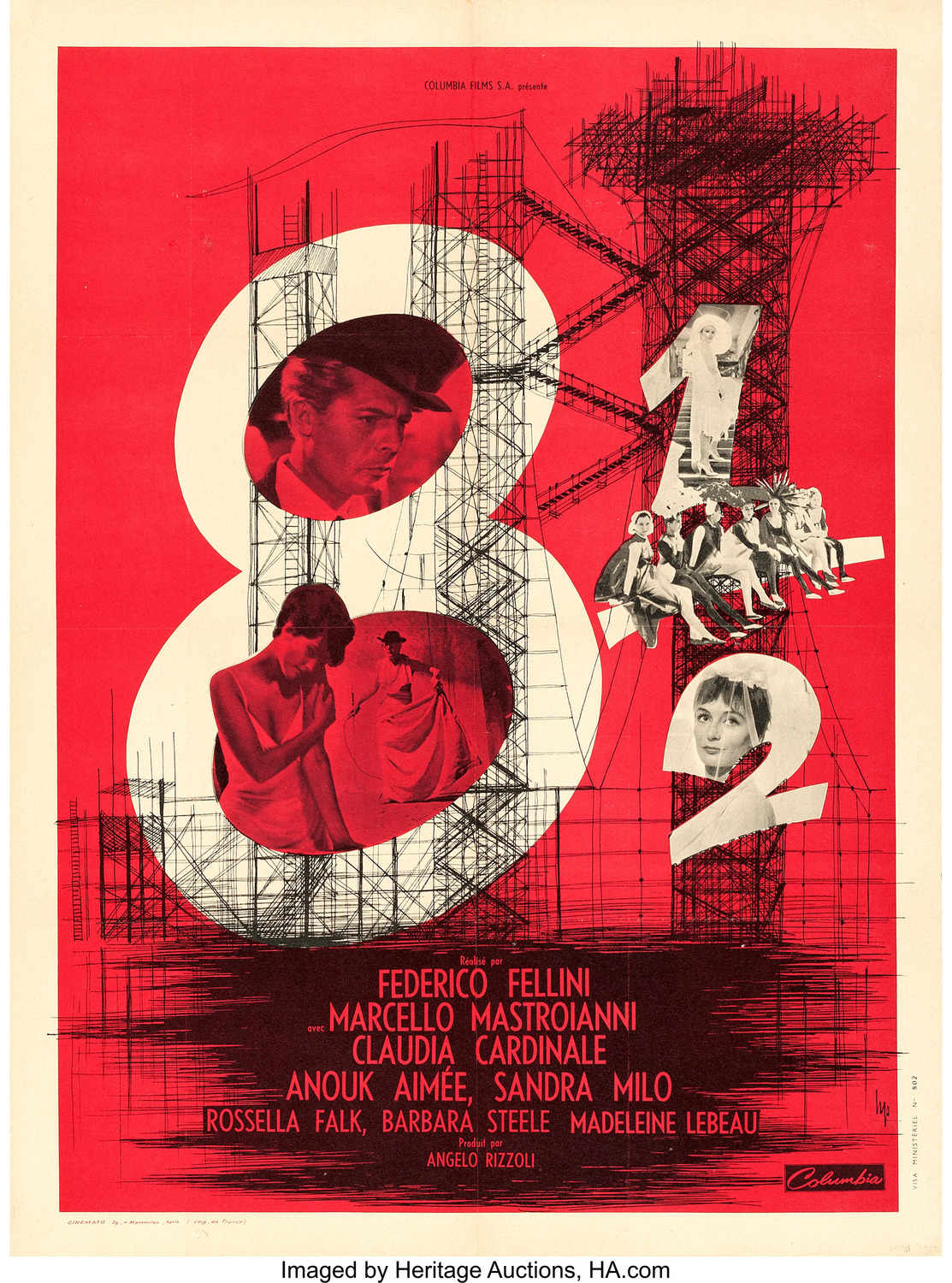
What the Film Is About
Federico Fellini’s 8½ is less a conventional narrative than a cinematic meditation on the creative process, crisis, and self-examination. At its most fundamental level, the film follows Guido Anselmi, a successful film director paralyzed by self-doubt and artistic exhaustion as he attempts to begin his next project. Yet, the film is not truly concerned with plot; instead, it charts Guido’s spiraling emotional journey as he navigates memory, fantasy, and reality, all colliding within his fragmented psyche. The central conflict emerges from Guido’s inability to reconcile his artistic ambitions with his personal life, his desires with his responsibilities, and his search for meaning with the chaotic swirl of the inner and outer worlds.
What makes 8½ distinctive is its refusal to provide easy answers or linear progression. Instead, it envelops the audience in Guido’s disorienting experience, mirroring the struggles of anyone who has faced a crisis of purpose, especially in a world that demands continual production and certainty. The narrative direction becomes an emotional odyssey — not just for Guido, but for anyone who has ever questioned the true nature of their identity and calling.
Core Themes
8½ explores a tapestry of themes centered around identity, creativity, memory, escapism, and the burdens of expectation. At the film’s core lies the anxiety of artistic creation: Guido is haunted by the pressure to craft something meaningful while doubting whether he has anything left to say. This creative paralysis is intimately linked to broader questions of authenticity, as he grapples with what is genuinely his own versus what is merely performed for others’ approval.
Closely related are reflections on memory and the passage of time. The film blurs lines between past and present, reality and dream, suggesting that who we are is an unstable collage of recollections, regrets, and desires. 8½ also interrogates gender dynamics, particularly in Guido’s relationships with women. The idealization and objectification of women reveal both personal neuroses and broader cultural attitudes prevalent in 1960s Italy.
Upon its release in 1963, these themes resonated with a society in the midst of transformation—where notions of tradition, gender, and artistic integrity were under scrutiny. Today, 8½ remains relevant in an age grappling with anxieties of authenticity, burnout, and the weight of expectations, reminding viewers that the inner search for meaning transcends time and context.
Symbolism & Motifs
Few films deploy symbolism with such liberating inventiveness as 8½. The imagery is less about logical metaphor and more about emotional resonance. One recurrent motif is the circus—both literally, in the final scenes, and figuratively, as a stand-in for the chaos and performance implicit in both artistic creation and human existence. The haunting opening scene, in which Guido dreams of suffocating in a car and then flying away above the traffic, establishes a visual language for feelings of entrapment and the desire for release.
Mirrors and reflections appear frequently, underscoring questions of identity and the struggle to accurately perceive oneself. The recurring use of spirals and circles—visible in dance sequences, dreams, and staging—symbolize the cyclical, inescapable nature of Guido’s dilemmas. Furthermore, the motif of women as both muse and barrier lays bare Guido’s subconscious struggles, showing how the roles and expectations projected onto others can become both inspiration and prison.
Even the film set itself operates symbolically: the unfinished spacecraft and half-constructed sets reflect the incompleteness of Guido’s vision, blurring the line between creation and collapse. Ultimately, the film’s dreamlike structure is itself a motif, inviting viewers to experience consciousness as a flux rather than a fixed state.
Key Scenes
Key Scene 1
The surreal opening dream sequence, in which Guido is trapped in a smoke-filled car before floating away into the sky, is central to the film’s emotion and philosophy. The scene’s importance lies not simply in its visual inventiveness, but in how it encapsulates the conflict between suffocation and flight; between being hemmed in by expectation, fear, and routine, and the yearning to escape them. This fusion of anxiety and longing becomes the psychic landscape that defines not just the character’s journey, but the very essence of the film’s critique of modern life and artistic struggle.
Key Scene 2
The harem fantasy sequence, in which all of Guido’s lovers are gathered under one roof to serve and adore him, functions as a pointed exploration—and ultimately a critique—of desire, power, and the limitations of wish-fulfillment. On one hand, it externalizes Guido’s subconscious: his yearning for adoration and control over the women in his life. On the other, the fantasy quickly devolves into chaos, rebellion, and ridicule, exposing the emptiness and unsustainability of such escapist dreams. The scene lays bare the contradictions of Guido’s psyche, highlighting the way fantasies often serve as both escape and self-imposed prison.
Key Scene 3
The film’s closing sequence—the exuberant circus parade—serves as an emotional and thematic culmination. Figures from throughout Guido’s life—friends, lovers, collaborators, critics—join hands in a joyful dance, with Guido himself descending into the ring to participate at last. This scene represents an acceptance of life’s contradictions and imperfections. Rather than seeking a perfect, finished work or a resolution to all questions, Guido embraces imperfection and community. The ring’s circular dance underscores the cyclical nature of existence and the possibility of finding harmony in the acceptance of chaos. The scene delivers a final statement: meaning is found not in artistic or personal perfection, but in reconciliation with life as it is.
Common Interpretations
Critics and audiences have long viewed 8½ as a profoundly autobiographical film—a “film about filmmaking” and, by extension, about the anxiety of artistic creation in any field. Many interpretations focus on Guido as a stand-in for Fellini himself, representing the crisis of inspiration and self-doubt familiar to any creator. Others see the film as a general meditation on the self and the impossibility of ever fully understanding, or articulating, one’s own desires and motivations.
There are also readings that emphasize the film’s philosophical and psychoanalytic dimensions, interpreting its dream sequences and fragmentation as an exploration of the unconscious mind. Feminist critics have questioned the film’s portrayal of women, seeing it both as an honest depiction of male fantasy and a perpetuation of objectifying tropes, yet others argue that the film is acutely self-critical in this respect. Some interpretations focus more on the broader existential issues: the inescapability of doubt, the necessity of compromise, and the ultimate freedom of embracing ambiguity.
Despite differences in approach, most agree that 8½ is not offering a roadmap to resolution, but rather an invitation to experience the messiness of selfhood and creativity—one that is, paradoxically, both deeply personal and profoundly universal.
Films with Similar Themes
- All That Jazz (1979) – Bob Fosse’s semi-autobiographical musical also delves into the creative process, self-destruction, and the blurred boundaries between life and art, mirroring 8½’s exploration of a director in crisis.
- Synecdoche, New York (2008) – Charlie Kaufman’s surreal drama about a theater director unable to complete his magnum opus echoes 8½’s themes of existential doubt, artistic paralysis, and the search for meaning within chaos.
- Adaptation. (2002) – Like 8½, Spike Jonze’s film (written by Charlie Kaufman) is meta-cinematic and examines creative block, self-referentiality, and the tension between reality and invention.
- Bergman’s Wild Strawberries (1957) – While not about filmmaking, Ingmar Bergman’s meditation on memory, regret, and the passage of time similarly weaves together dreams and reality to probe questions of identity and self-acceptance.
Ultimately, 8½ communicates that the search for meaning—whether in art, relationships, or self-knowledge—is inherently fraught, cyclical, and incomplete. It champions honesty with oneself, acceptance of imperfection, and the embracing of ambiguity over false certainty. In so doing, the film stands as both a reflection of its era’s anxieties and an enduring statement on the challenges and beauty of being human.