
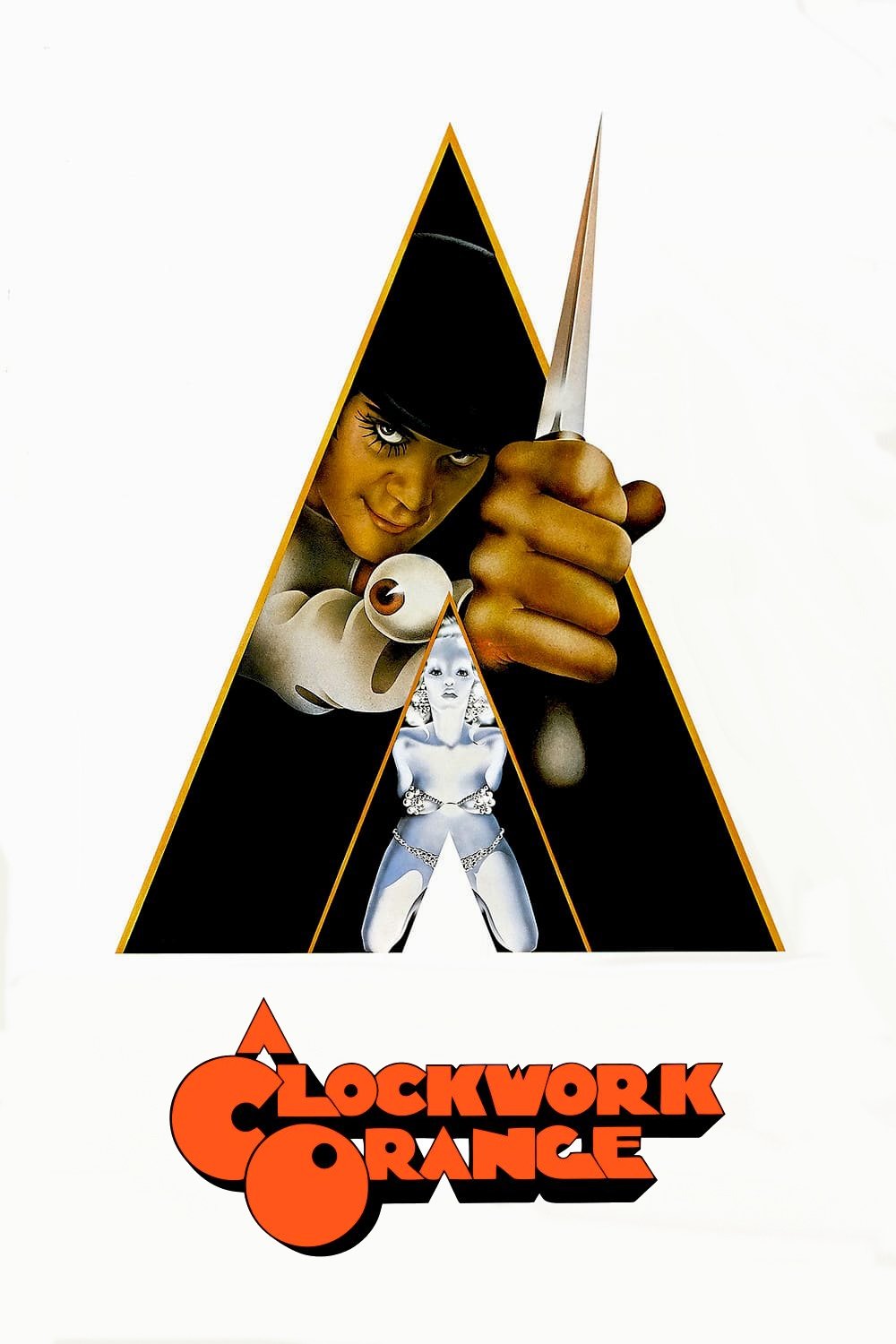
What the Film Is About
Stanley Kubrick’s adaptation of Anthony Burgess’s novel, A Clockwork Orange is ultimately a disturbing and visceral meditation on free will, societal control, and the very nature of evil. The film follows Alex, a charismatic but sociopathic youth, as he indulges in violence, experiences state-enforced rehabilitation, and faces the implications of losing his own agency. More than just a portrait of violence, the film is about a confrontation—between individual chaos and the machinery of a controlling society. At its core, it traces the emotional and psychological journey of its protagonist and, by extension, the audience, forcing us to question the boundaries between justice, morality, and freedom.
Throughout, the narrative aims not to comfort, but to unsettle—to push viewers to examine their own responses to violence, punishment, and the cost of conformity. The central conflict emerges between the unruly passions and desires of the individual versus society’s attempts to regiment, repress, and sanitize those instincts, regardless of the ethical cost.
Core Themes
At the heart of A Clockwork Orange lies a cluster of themes as provocative today as they were in 1971. Foremost is the tension between free will and social conditioning. The film asks whether it is preferable for a person to choose evil over being compelled to do good. The Ludovico Technique, with its forced behavioral conditioning, symbolizes a society that values compliance over conscience, raising fundamental questions about what it means to be human.
Another major theme is the role of violence—not merely as spectacle, but as a pervasive force infiltrating both individual behavior and institutional power. By presenting violence in stylized, almost seductive fashion, Kubrick destabilizes any easy moral judgment, compelling the viewer to confront their own complicity as spectators.
Identity and moral autonomy are also central. Alex’s journey is, paradoxically, one from charismatic villain to victimized subject, inviting reflection on the malleability of morality in the hands of those with authority. Rebellion and control, justice and punishment, the individual and the collective—all are interrogated through the unflinching lens of dystopia.
When the film was released, its themes resonated with anxieties of the late 1960s and early 1970s: social upheaval, the rise of youth culture, and fears of growing authoritarianism. Today, in an era of renewed discussion about surveillance, criminal justice, and personal liberty, the film’s core questions retain urgency and power.
Symbolism & Motifs
Kubrick’s visual and narrative strategy overflows with symbols and motifs that deepen the moral ambiguity and reinforce the film’s philosophical arguments. The film’s title itself, “A Clockwork Orange,” serves as a central metaphor: a reference to something organic made mechanical, or a human being stripped of true agency and reduced to function like a clockwork toy.
Ultra-violence, as perpetrated by Alex and his “droogs,” is presented in highly stylized tableaux, often juxtaposed with classical music. These juxtapositions—particularly Alex’s love of Beethoven—highlight the uneasy coexistence of beauty and brutality within the human soul, and invite the viewer to question the nature of evil.
Milk, as served in the Korova Milk Bar, works as a motif of innocence perverted, and of substance laced with danger. Its sterile whiteness contrasts sharply with the colorful, lurid violence that follows, blurring the line between purity and corruption.
The recurring use of eye imagery—Alex’s exaggerated false eyelashes, and more chillingly, the pried-open eyes during the Ludovico Technique—serves as a motif for enforced vision and enforced experience. The viewer, too, is forced to “watch” and confront discomforting truths, just as Alex cannot close his eyes to the images the state wants him to internalize.
These motifs collectively reinforce the film’s central message about the dangers of dehumanization—whether through individual acts of cruelty or through systematic, institutionalized control.
Key Scenes
Key Scene 1
Alex’s participation in the Ludovico Technique is one of the film’s most crucial sequences for understanding its philosophical core. Here, the protagonist is physically restrained, his eyelids clamped open, and is forced to watch images of violence while being injected with aversion-inducing drugs. This scene is emotionally brutal not just for Alex, but for the audience, highlighting the horrors of state-mandated “rehabilitation.” Symbolically, it represents the stripping away of a person’s moral agency in the name of social order. The discomfort of both Alex and the viewer drives home Kubrick’s challenge: is a person who loses the capacity to choose evil still fully human?
Key Scene 2
Another pivotal moment occurs when Alex, after his conditioning, becomes the victim of those he once tormented. Stripped of his violent impulses, he is powerless before a world that still teems with cruelty and vindictiveness. This inversion complicates our initial judgments about Alex and his victims, exposing the cyclic nature of violence and the potential for victimhood within all of us. The film suggests that suppressing one form of brutality does not eradicate evil; instead, it may simply redistribute suffering or empower new agents of harm.
Key Scene 3
In the final scenes, when Alex is “cured” of his conditioning and recovers his old self, the film reaches a bleak yet ambiguous climax. Alex’s re-embrace of violence is not presented as triumphant, but as an indictment of a society that has failed to address the deeper origins of destructive behavior. The cyclical nature of violence and repression is underscored, and the viewer is left to grapple with the unsettling idea that both the state and the individual are caught in an endless dance of corruption, hypocrisy, and harm. The closing moments reinforce Kubrick’s cautionary message: without true moral choice, neither individual redemption nor societal harmony is possible.
Common Interpretations
A Clockwork Orange has provoked passionate and varied responses among critics and audiences. One dominant interpretation centers around its critique of state power—the idea that societal attempts to eradicate evil through force, censorship, or psychological manipulation are not only futile but fundamentally inhuman. For many, the film’s real target is the dehumanizing logic of institutions that prioritize order and docility above all else.
Another widespread reading emphasizes personal freedom and moral agency. Some see Alex as a dark avatar for the necessity of choice, however troubling those choices may be. The film suggests that without the possibility of doing wrong, the virtue of doing right loses its meaning.
A third interpretation focuses on the portrayal of violence and the complicity of the audience. Kubrick’s artistic presentation of brutality blurs the boundaries between attraction and repulsion, implicating viewers in the act of watching and, perhaps, consuming violence as entertainment or catharsis.
There is also debate over whether the film is nihilistic or satirical—a warning about unchecked authority and social engineering, or a darkly comic critique of postwar English society. While most interpretations recognize the film’s challenge to simplistic moralizing, they diverge on whether Kubrick ultimately sides with anarchic individualism, cold institutionalism, or maintains a cynical distance from both.
Films with Similar Themes
- Brazil – Explores the dangers and absurdities of bureaucracy and social control in a dystopian future, echoing themes of individual autonomy versus institutional oppression.
- One Flew Over the Cuckoo’s Nest – Examines the consequences of forced conformity and the human cost of psychiatric and societal “treatment.”
- Fight Club – Probes identity, violence, and rebellion against consumerist, controlled society, much like A Clockwork Orange’s tension between individual will and social expectation.
- THX 1138 – Focuses on the mechanization and dehumanization of society and the struggle to retain humanity within oppressive systems.
In sum, A Clockwork Orange remains a troubling and prescient work—one that interrogates the price of “civilization” in a world willing to crush personality and dissent in the name of security and order. By forcing viewers to occupy both complicity and discomfort, Kubrick’s film ultimately communicates that true humanity is bound up in the freedom to choose, even when those choices disturb or defy societal expectations. It is a meditation on the dark corners of human nature and the dangers of authority that sacrifices conscience for control, a statement as relevant to our present moment as it was to the era in which it was made.