
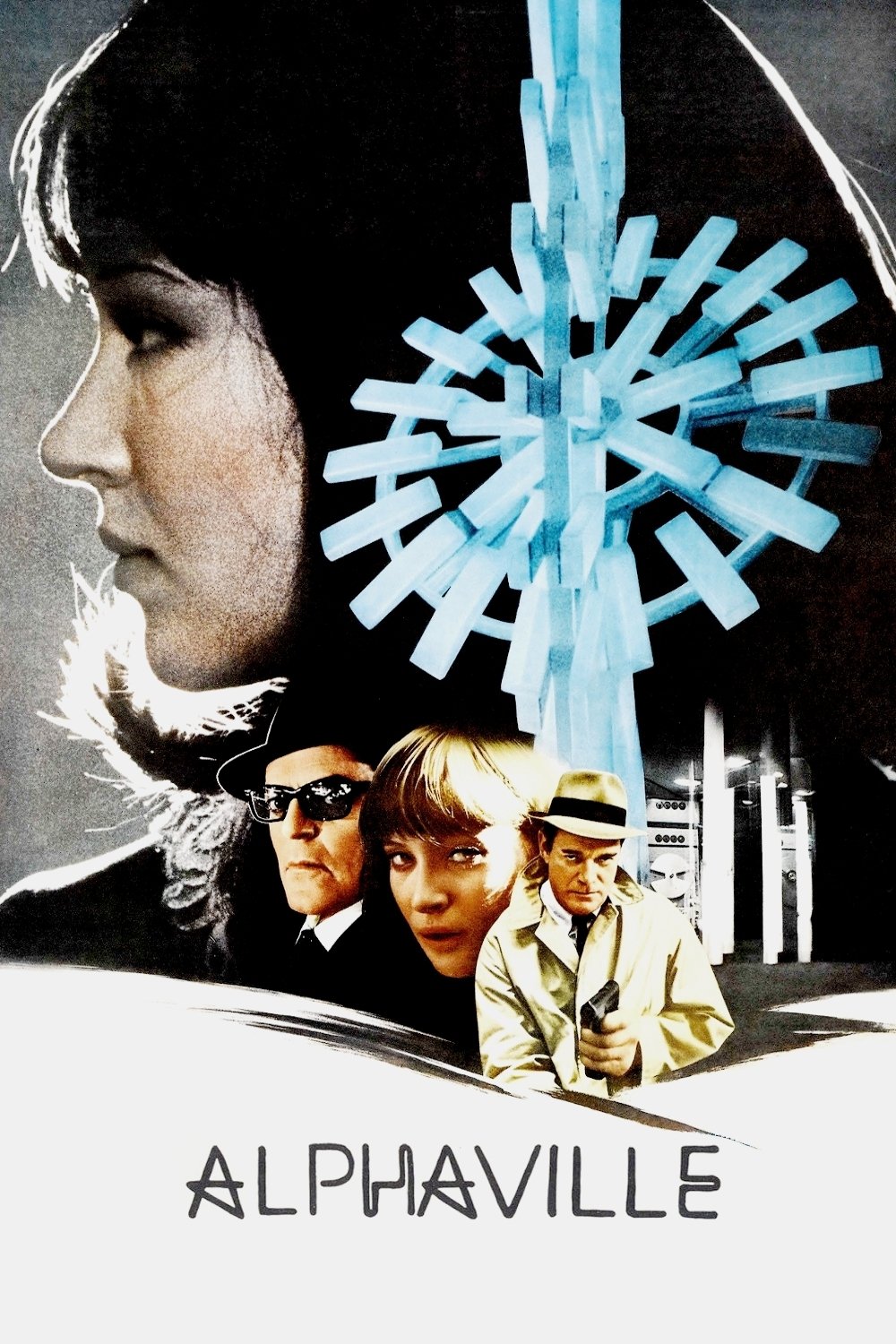
What the Film Is About
“Alphaville,” directed by Jean-Luc Godard, is a profoundly enigmatic work that drifts between science fiction, noir, and philosophical allegory. Instead of guiding viewers through a conventional plotline, the film immerses them in an emotionally charged odyssey, following a lone protagonist navigating a futuristic city governed by a strict regime of logic and reason. At its core, the film grapples with the existential tension between emotion and rationality, tracing the journey of a man who resists the suppression of feeling and individuality for the sake of societal control. The central conflict is a psychological and ethical one—between a bureaucratic machine’s insistence on order and a human need for poetry, love, and self-expression.
The narrative arc isn’t about resolving external events so much as about awakening the protagonist (and, by extension, the viewer) to the cost of sacrificing humanity on the altar of cold reason. The story’s emotional thrust stems from its isolation and sterility, gradually giving way to a luminous, fragile hope in the promise that even under oppressive rule, love and identity can survive.
Core Themes
At the heart of “Alphaville” are themes of dehumanization through overreliance on technology and the suppression of emotion in the pursuit of order. The film interrogates the ideology of a society that values efficiency, uniformity, and logic to the exclusion of art, ambiguity, and desire. One of its primary thematic concerns is the peril of unchecked rationalism: “Alphaville” suggests that while reason may yield control, it also breeds spiritual sterility and alienation.
Another central theme is the resistance of the human spirit. The protagonist’s journey exposes the limits of totalitarian logic and shows how poetry and love act as forms of rebellion. These themes resonated powerfully in the 1960s, when anxieties about bureaucracy, automation, and individuality loomed large during the early days of the computer age. Today, as society confronts new questions about artificial intelligence and algorithmic governance, the film’s warnings feel more prescient than ever. It challenges audiences to consider what is lost when emotion, creativity, and complexity are subordinated to mechanical control.
Symbolism & Motifs
Godard employs a rich tapestry of symbols and recurring motifs to deepen the film’s meaning. The city of Alphaville itself is a symbol of modernity gone awry, where neon-lit corridors and grid-like architecture evoke both futuristic promise and oppressive monotony. The omnipresent supercomputer, Alpha 60, is more than a piece of technology—it’s the godlike authority, demanding conformity and rationality from all under its gaze.
A recurring motif is language, specifically the mechanical reduction of words and the banning of poetic or ambiguous expressions. This “newspeak” style signals the systematic erasure of emotional nuance, with dictionaries in the city regularly purged of forbidden concepts. Water, mirrors, and corridors recur throughout, reflecting not only the protagonist’s internal search but also his dislocation—the unending attempt to find meaning in a world drained of the irrational, the irrational being precisely what makes us human.
Key Scenes
Key Scene 1
A pivotal early moment occurs when the protagonist first arrives in Alphaville and is interrogated by Alpha 60’s disembodied voice. This unsettling confrontation establishes the dehumanizing logic of the city: questions are mechanical and devoid of empathy, and answers are expected to be purely factual. The chilling lack of emotional resonance in this exchange dramatizes what’s at stake in Alphaville—the human soul at risk of being crushed by algorithmic order. This scene is crucial, emotionally and symbolically, because it situates viewers in the film’s central dilemma and stresses the cost of eliminating feeling from public life.
Key Scene 2
Later, the protagonist secretly shares passages of romantic poetry with Natacha, a resident of Alphaville raised to suppress her feelings. He encourages her to witness the beauty and ambiguity in words that the regime has tried to erase. This intimate moment develops the film’s themes by directly challenging the logic of the system and inspiring emotional awakening. The scene reveals the subversive power of language and underscores the film’s argument that love and poetry are forms of resistance against inhuman rationality. The characters’ connection becomes a microcosm of hope, suggesting that even in a strictly controlled society, individuality and compassion can survive through shared acts of bravery.
Key Scene 3
The film’s climax, in which Alpha 60 is ultimately defeated by an illogical riddle, represents a decisive turning point—logic collapses before the unquantifiable experience of love. This moment reaffirms the central message: the essence of humanity is not measurable or rule-bound, and systems attempting to reduce life to equations will always encounter the unpredictability of human emotion. By foregrounding poetry and love as forces that no machine can predict or control, the film leaves us with a resonant, open-ended vision of hope beyond dystopia.
Common Interpretations
“Alphaville” has been interpreted through a variety of critical lenses, many of which focus on its critique of rationalist, technocratic societies. Some see it as a warning against the mechanization of everyday existence and the dangers of bureaucratic authoritarianism—echoing postwar fears of both Soviet collectivism and Western corporate capitalism. Others interpret the film as a celebration of language and literature, positing that art provides the last refuge from totalitarianism.
There is also a widely accepted reading that views the alienating effects of the city as a metaphor for contemporary life in the rapidly modernizing 1960s, particularly the growing sense of urban isolation and emotional disconnect. While some audiences are drawn to its existential uncertainties, others treat the film as a biting satire, using science fiction trappings to lampoon both genre conventions and real-world social structures. Ultimately, the film is seen as both a political allegory and a philosophical parable about the irreducibility of the human spirit.
Films with Similar Themes
- Blade Runner (1982) – Explores the conflict between artificial logic and human emotion in a dystopian society obsessed with control and efficiency.
- THX 1138 (1971) – Examines lives in a futuristic society where emotion and individuality are suppressed by authoritarian rule, echoing Godard’s anxieties about dehumanization.
- Brazil (1985) – Uses absurdist and surreal imagery to critique bureaucratic control and the crushing of imagination, aligning with “Alphaville’s” warnings about oppressive systems.
- Metropolis (1927) – Depicts a starkly divided, technocratic city and the struggle to reconnect with human empathy and purpose beneath mechanical order.
“Alphaville” ultimately stands as a poetic meditation on the limits of rationality and the enduring necessity of emotion in defining what it means to be human. Though rooted in the anxieties of the 1960s, its cautions about the automation of life and the elimination of the unpredictable in favor of control remain deeply relevant. The film’s enduring power lies in its insistence that even the most perfect machine cannot extinguish the human need for connection, ambiguity, and love.