
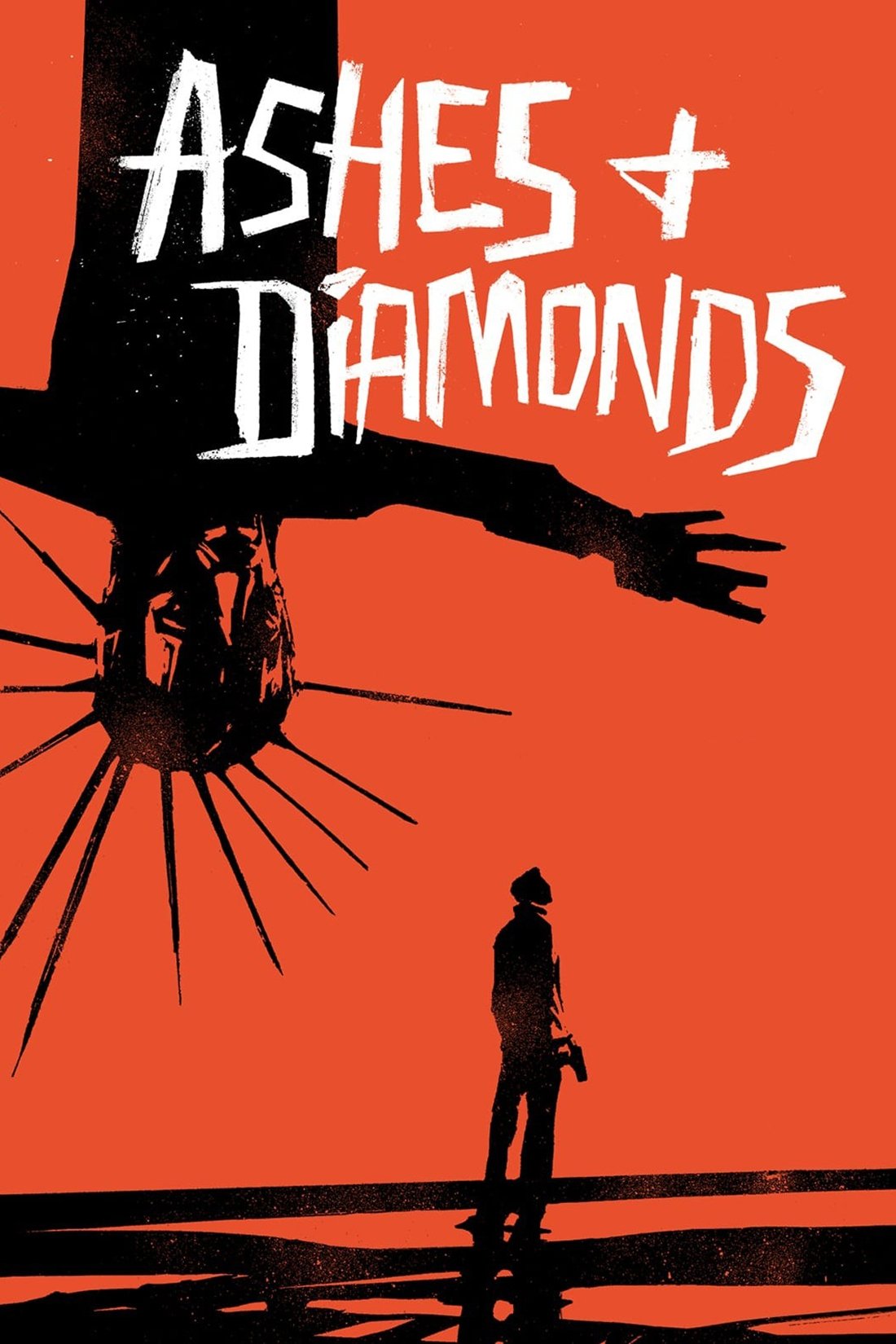
What the Film Is About
Ashes and Diamonds has always struck me as a film haunted by uncertainty—a living document of the emotional crossroads that consumed Poland in the closing hours of World War II. When I first encountered this movie, I was immediately drawn to the way it immerses viewers in the turbulence of its setting. Rather than diagramming good and evil, loyalty and treason, the narrative is shaped by moral ambiguity and the paralysis of choice. At its center is the figure of Maciek, a resistance fighter whose inner conflict embodies the psychic wounds of a nation on the cusp of liberation but shadowed by new ideological constraints. The entire film pulses with a sense of suspended time, of personal and national futures hanging in the balance, where emotional attachments collide with the larger imperatives of history.
What I found most affecting was the sense that every character is holding their breath, feeling the enormity of what has passed and the dread of what is to come. It isn’t a straightforward tale of heroism or betrayal; rather, it’s a meditation on disillusionment, sacrifice, and the cost of survival. The overarching conflict, to me, revolves around the impossible task of choosing one’s role in a transitional moment: to move forward, look back, or simply stand still as the world is rewritten around you.
Core Themes
When I reflect on the central concerns of Ashes and Diamonds, I see a tapestry woven from the threads of disillusionment, political ambiguity, and the anxiety of identity. The film doesn’t deliver clear answers about right action or clear villainy. Instead, it ponders how morality is colored by context—how acts of violence done in the name of patriotism both scar the soul and obscure the very ideals they were meant to defend. The question I keep returning to is: What do such acts ultimately buy—a new beginning, or another round of suffering?
The theme of divided loyalty feels especially acute. I was struck by how Maciek embodies that most profound of generational quandaries: whether to obey the momentum of history or try to step off its relentless track. His longing for intimacy and peace is undermined by inherited obedience to causes larger than himself. That ferocious friction—between personal happiness and collective duty—gives the film its melancholy charge. Love, violence, and ideology are locked together in a sorrowful embrace, each robbing the other of their innocence.
Viewed in the political context of 1958 Poland, I sense the film is as much about the terror of ‘tomorrow’ as it is about the vestiges of occupation and war. Andrzej Wajda, in my reading, channels the anxieties of a generation both liberated and trapped: as Nazi rule ended, Soviet hegemony began. The film’s meditation on the price of transition, and its skepticism about whether sacrifices really clear a path to renewal, resonates just as powerfully today—whenever societies redefine themselves in the wake of crisis or revolution.
For me, Ashes and Diamonds endures because its questions remain unresolved. Can violence ever be redeemed by the future it intends to secure? Can a person find a true self amid shifting allegiances? The film offers no easy comfort—only the tragic grandeur of living honestly in ambiguous times.
Symbolism & Motifs
What sets Ashes and Diamonds apart, in my eyes, is its rich use of recurring visual cues and symbols. The titular imagery—ashes and diamonds—remains as enigmatic as it is evocative. To me, diamonds suggest all our bright ideals, hardened through immense pressure; ashes point to the destruction and disillusionment left in the wake of those very dreams. The film seems to ask: which will define us in history’s memory—the gleam of what we hope to become, or the dust of what we have lost?
One motif I find especially affecting is the constant presence of fire and light. The flicker of candles, the explosive violence, and the mundane glow of neon signs all create a landscape where illumination reveals and destroys in equal measure. A recurring sequence in which Maciek ignites vodka in shot glasses—turning them into tiny, fleeting pyres—feels like an elegy for transient hope: all brilliance is fated to fade, but maybe in that brief moment it can cast genuine warmth or beauty.
Mirrors and glass surfaces appear throughout, reflecting characters back on themselves or distorting their images. To me, these act as subtle meditations on fractured identity and the impossibility of seeing oneself— or one’s country—clearly after trauma. The hotel, with its transitory population and impersonal décor, becomes both a sanctuary and a prison: a liminal space where every negotiation is fraught, every encounter shaped by the pressure of imminent change.
I’m also drawn to the motif of celebration tinged with anxiety. As Poland marks both the end of occupation and the start of a new political era, the camera lingers on revelers whose joy rings hollow beneath the surface. It’s as if the film is forever questioning the legitimacy—or endurance—of any “victory” built on so much sorrow.
Key Scenes
Key Scene 1
The image that always comes to mind first is Maciek’s brief, luminous tryst with Krystyna in the hotel. This scene, for me, encapsulates the movie’s central paradox: the longing for real connection in a time when intimacy is fundamentally compromised by guilt and the weight of impending violence. Their chemistry feels deeply human, a flicker of what could be possible if only the world allowed it. This isn’t merely a love scene—it’s an oasis of warmth, framed against the chill of obligations and mourning. The silence and vulnerability shared between them impart a sense of what’s at stake: every tenderness is endangered by the context around it. I see this as the film’s emotional heartbeat—making plain what could be saved or lost in the blink of an eye.
Key Scene 2
Another scene that stays with me is the moment Maciek sets the flaming vodka glasses alight in the dim bar, a ritual both playful and funereal. The blue flames burn briefly, captivating those around the table, before vanishing into darkness. For me, this is more than a striking image; it’s a microcosm of the entire film’s worldview—transient beauty, hope that cannot last, and the destructive fire at the heart of all revolutionary promise. I interpret the spectacle as a silent lament: every fleeting joy is mirrored by equally fleeting peace. The onlookers’ measured wonder hints at collective exhaustion; it’s as if everyone knows, on some level, that even their moments of pleasure rest on the edge of catastrophe.
Key Scene 3
My personal reckoning with Ashes and Diamonds always culminates in the film’s final moments—Maciek’s attempt at escape and his lonely, almost animal death among the garbage bins behind the church. This sequence operates as both a literal and symbolic denouement: the would-be hero felled not in glorious combat, but in squalor and anonymity. This ending, for me, is the director’s ultimate statement on the costs of political violence and the vagaries of fate. All the fire and promise of revolution lead, in this reading, not to renewal but to oblivion. I can’t help but see this not just as an indictment of individual sacrifice, but as a lament for any society that trades its future away in the name of absolutism, only to bury its idealists unsung and forgotten.
Common Interpretations
In conversations with fellow critics and cinephiles, I’ve encountered several major schools of thought about Ashes and Diamonds. A dominant interpretation focuses on the film as a meditation on the futility—and tragedy—of revolutionary violence. Many see Maciek as a spiritual brother to Shakespeare’s Hamlet: paralyzed by the gravity of action, haunted by the ghosts of his cause, yearning for meaning but delivered only to loss. This view often frames the story as a warning against the dehumanizing effects of ideological warfare, where noble intentions are inevitably dashed against the rocks of circumstance.
Others contend that the film operates as a national allegory; in this reading, the characters become stand-ins for the moral confusions of postwar Poland. The tension between personal desire and historical necessity is seen not just as Maciek’s dilemma, but as the psychic ordeal of an entire generation forced to bear the cost of impossible choices. Some critics highlight the ambiguity of the “enemy” in the film, suggesting that Wajda is less concerned with prescribing blame than with tracing the way all sides are corrupted by the urgency of their convictions.
A smaller group finds in the film a kind of existential poetry, arguing that Maciek’s suffering and longing point to broader questions about the search for meaning in a world irrevocably broken by violence. For these viewers, the film’s bleakness isn’t pure nihilism, but a call to face hard truths about the cost of hope and the weight of conscience.
What unites all these interpretations, from where I stand, is the sense that Ashes and Diamonds offers no easy answers. Its enduring legacy comes from the way it compels us to confront the gray areas between heroism and compromise, between the fire of revolution and the ashes left behind.
Films with Similar Themes
- The Third Man – In my opinion, this film’s haunted, war-damaged cityscape and morally ambiguous protagonist offer a kindred meditation on trust, betrayal, and the shadowy aftermath of conflict.
- The Cranes Are Flying – Much like Ashes and Diamonds, this Soviet masterpiece explores the impact of war on individual dreams and relationships, focusing on how personal tragedy is inextricable from historical events.
- Army of Shadows – This film’s unflinching depiction of resistance, sacrifice, and ethical ambiguity during wartime France reminds me of Wajda’s willingness to challenge simplistic notions of heroism and faith.
- Come and See – In both films, I see a relentless questioning of innocence, trauma, and the overwhelming destructiveness of war—never glorifying violence, but exposing its suffocating cost on the human soul.
Ashes and Diamonds, in my reading, ultimately communicates a sorrowful wisdom about how history turns ordinary people into both agents and victims of unstoppable tides. Watching the film feels, to me, like stumbling through the twilight of a great storm—blinded by possibility and dread, reaching for meaning in the ruins. Wajda’s achievement is his refusal to romanticize either side of the conflict. Instead, he places us in the unease of the ‘in between,’ where neither victory nor defeat offers comfort, and where the only certainty is the burden of memory. For anyone seeking to understand the moral complexity of transitional eras—or the aching search for identity in the aftermath of violence—I believe Ashes and Diamonds will always have the last, most devastating, word.
To explore how this film has been judged over time, consider these additional viewpoints.