
What the Film Is About
Watching Force of Evil always feels less like taking in a story and more like being swept up in a fever dream of ethical compromise and spiritual erosion. What I see at its core is not a mere crime melodrama, but a raw, almost desperate journey into the heart of conflicted ambition. The film’s emotional impact comes not from the trappings of its plot, but from the suffocating tension between loyalty and self-preservation, and the slow realization of how easy it is to lose one’s way in a morally ambiguous world.
For me, the central conflict lies in the internal war that rages within its protagonist, a man whose yearning for success leads him to betray not only his sense of right and wrong, but also the fragile bonds of family. As the narrative unfurls, it’s this messy, private battle—a lawyer grappling with conscience while enabling corruption—that sets the film’s urgent, anxious tone. The story’s direction isn’t towards resolution, but towards a reckoning—a reckoning with self, with brotherhood, and with the seductive logic of evil that tempts us all toward ruin.
Core Themes
If someone asked me what truly animates Force of Evil, I’d start by pointing to its meditation on morality in a rigged and unforgiving world. The film doesn’t lecture me with ethics; instead, it forces me to squirm alongside its protagonist as I witness the alarming proximity between success and moral failure. The idea that unchecked ambition inevitably leads to spiritual bankruptcy was never more relevant to me than here, perhaps because the film never sentimentalizes its characters. It forces me to ask: How much can I compromise before I become complicit in my own destruction?
The theme of brotherhood, and by extension, loyalty, sits heavily on every frame. Watching two brothers—one polished, one battered—navigate a corrupt landscape, makes me reflect on the choices we make for those we love, and how love can be contorted by self-interest. Loyalty, in this film, is both a shield and a burden. There’s also a feeling of inevitability, a fatalism simmering beneath the surface, which I interpret as a commentary on America’s postwar anxieties—where the game often seems fixed, and effort alone isn’t enough to escape the gravitational pull of systemic corruption.
What strikes me as remarkably current is how unflinching the film is in its portrait of moral grayness. In a society still reeling from the disillusionments of World War II, the sense that the institutions meant to protect us are corruptible was undoubtedly jarring. Even now, decades later, I find the film’s moral ambiguity disturbingly resonant, echoing my own doubts about power, capitalism, and the temptation to rationalize small evils in pursuit of personal gain.
Symbolism & Motifs
Every time I revisit Force of Evil, I’m struck by the way its visual language speaks just as loudly as its dialogue. Darkness, for instance, permeates nearly every scene—shadows consuming faces, cityscapes shrouded in gloom, staircases that seem to descend forever. To me, these aren’t just noir flourishes; they externalize the protagonist’s moral descent, making it nearly impossible for me to separate the city’s physical corruption from the rot spreading within the characters’ souls.
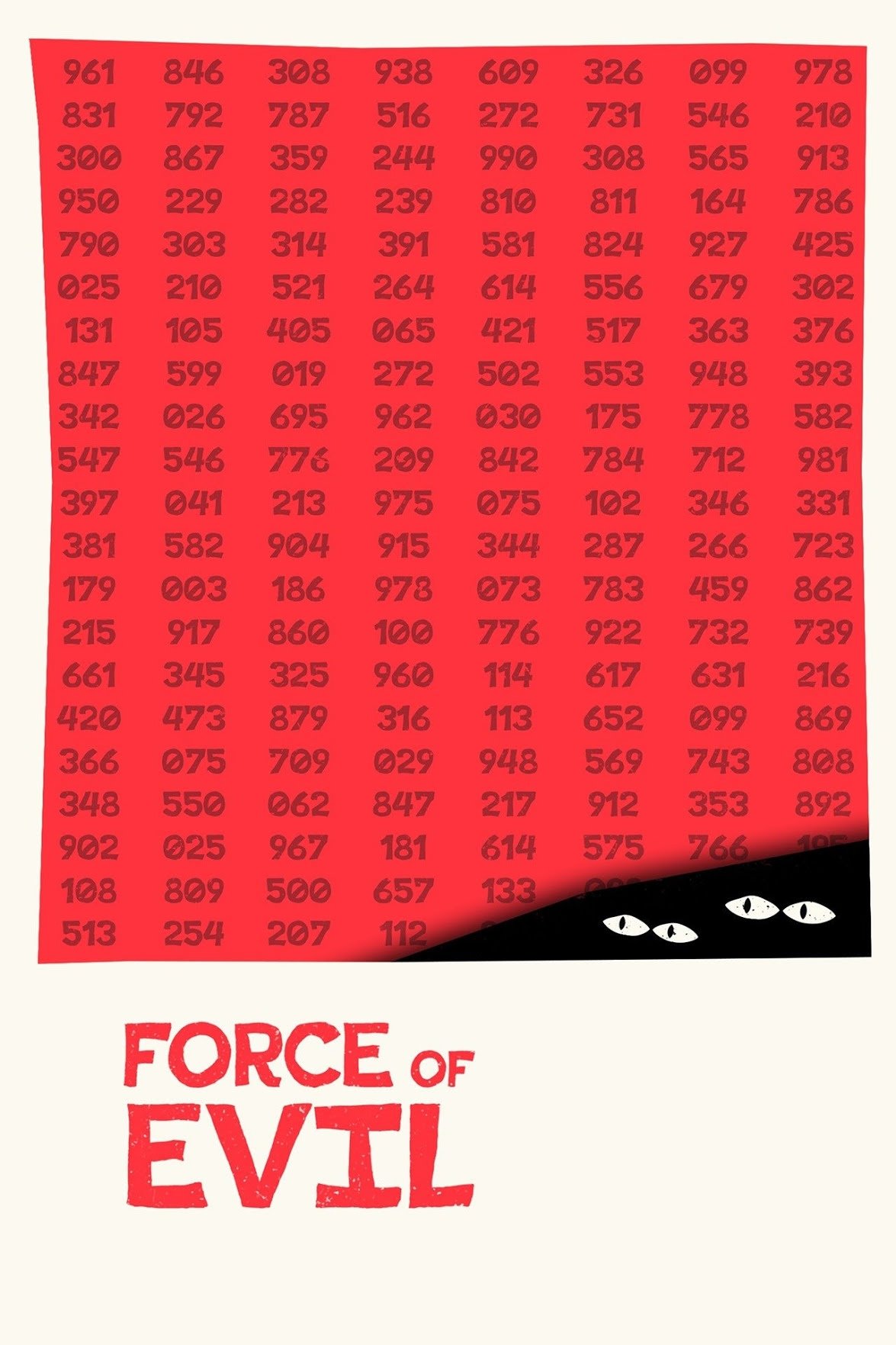
Stairways, elevators, and dizzying city exteriors repeatedly emerge throughout the film. To my mind, these motifs aren’t just about vertical movement, but about the illusion of upward mobility. The repeated ascents and descents reflect the fluctuating fortunes—and shifting morality—of the characters. It’s as if every climb brings them closer to power, but also further from their own integrity. The number 776, used in the film’s gambling operation, becomes more than just an unlucky number; I read it as a symbol of fate and the inescapable trap of the rigged system. Destiny, the idea that we might be doomed no matter our choices, hovers over every decision.
Even the city itself feels like a character to me, transformed into a labyrinth of danger, possibility, and betrayal. The ever-present noise of traffic, telephones, and ticking clocks—the hum of commerce and vice—serves not just as background, but as a persistent reminder that life, like the numbers racket at the film’s center, churns on with mechanical indifference to the suffering of individuals. This relentless atmosphere of pressure and claustrophobia adds an existential weight to the film’s themes, reinforcing my sense that every choice carries outsized consequences in a world that is both unpredictable and unyielding.
Key Scenes
Key Scene 1
The first scene that always lingers in my memory is when the protagonist, Joe Morse, visits his brother Leo’s small-time office. For me, this encounter transcends a simple family disagreement about business. Here, the film’s moral landscape is laid bare: two brothers standing on opposite sides of a chasm—one seduced by the promise of legality within criminality, the other stubbornly anchored in old-world ethics. The dynamic between them is charged with unspoken resentment, love, fear, and a deep longing for reconciliation. This moment, when Joe tries to save Leo from being crushed by the forces he himself is helping to unleash, is the emotional heart of the film, exposing the limits of good intentions and foreshadowing the agony of compromised loyalty.
Key Scene 2
Later, there’s a scene where Joe walks through the city at night, after realizing the full extent of the corruption he’s enabled. He becomes, in effect, a ghost wandering a landscape of his own making. What hits me about this sequence is not just the loneliness, but the growing self-awareness. The city’s looming skyscrapers, so promising earlier in the film, now appear menacing, indifferent. The meaning here isn’t just about regret; it’s about the gnawing recognition that complicity is itself a form of guilt, and that privilege purchased by betrayal leaves a permanent scar. I watch Joe’s swagger dissolve into haunted self-doubt, and I feel the film’s themes coalesce: the allure of power, the cost of conscience, and the slow death of hope under a regime of unchecked greed.
Key Scene 3
The final scene, with its haunting confrontation and tragic outcome, speaks to me as a moment of reckoning. As Joe confronts the consequences of his actions—not just personally, but as a participant in a system whose violence swallows everything—it becomes clear that redemption, if it comes at all, is not simple or clean. This is where the film, for me, stakes its ultimate claim: that self-realization comes at a heavy price, and that the courage to face what we have wrought is itself a form of dignity. The ambiguity of the film’s ending—neither completely despairing nor falsely redemptive—challenges me to reckon with the reality that change, when it comes, is paid for in suffering.
Common Interpretations
When I talk to others or immerse myself in criticism of Force of Evil, it’s clear how rich the interpretive landscape is. Some, like me, see it first and foremost as a searing indictment of American capitalism’s dark underbelly—a system where legality and criminality are two sides of the same coin. For many viewers, the lawyer at the center is a stand-in for every individual who has ever been tempted to rationalize unethical choices in the name of career advancement or the “greater good.”
Others focus more on the family dynamic, reading the film as a modern tragedy about brotherhood, sacrifice, and the impossibility of escaping one’s roots. The struggle between Joe and Leo—so bruising, so honest—reminds some critics of Shakespearean conflict, where tragedy is predestined not by villainy, but by weakness and love twisted by circumstance. Critics of the time often remarked on the film’s fatalism, interpreting the story as an allegory for individuals lost in an impersonal, corrupt world. There’s also a persistent interpretation which views the film’s stylized noir elements as projecting a nightmarish psychological reality, rather than a literal one—an approach that has only gained resonance in later decades as film noir itself has been reappraised.
Increasingly, viewers (myself included) recognize that Force of Evil isn’t content to offer clear heroes or villains. Instead, its refusal to provide easy answers or cathartic closure is now seen as a strength—a direct challenge to the certainties of mainstream postwar culture.
Films with Similar Themes
- Sweet Smell of Success – The richly cynical world of press agents and columnists in this film echoes the way Force of Evil explores ambition’s corrosive effect on integrity and human relationships.
- On the Waterfront – I see a deep kinship in these films’ portraits of individuals wrestling with conscience amidst pervasive corruption, and their focus on the cost of standing up—or failing to stand up—for what is right.
- Double Indemnity – The seductive logic of crime and the slippery descent into complicity is a motif that both films share, forcing me to question at which point personal responsibility gives way to fate.
- The Asphalt Jungle – Like Force of Evil, this film reveals the intricate machinery of crime and the futility of trying to outwit systems designed to exploit weakness, making me reflect on the blurred boundary between order and chaos.
What I ultimately draw from Force of Evil is a distinction between living and merely surviving in a world driven by unchecked power and unspoken deals. The film tells me that the ease with which we convince ourselves that “small” evils are justified can make us participants in tragedies much larger than we ever intended. It was born in an era when anxieties about American integrity—fueled by postwar disillusionment and a new recognition of systemic rot—were bubbling just beneath the surface. Yet watching it now, I feel its message is as vital as ever: that the battle between conscience and convenience is never really over, and that even in the darkest corridors of power, the hope for redemption begins with facing the truth about ourselves.
After learning the historical background, you may also want to explore how this film was received and remembered.